full body focus
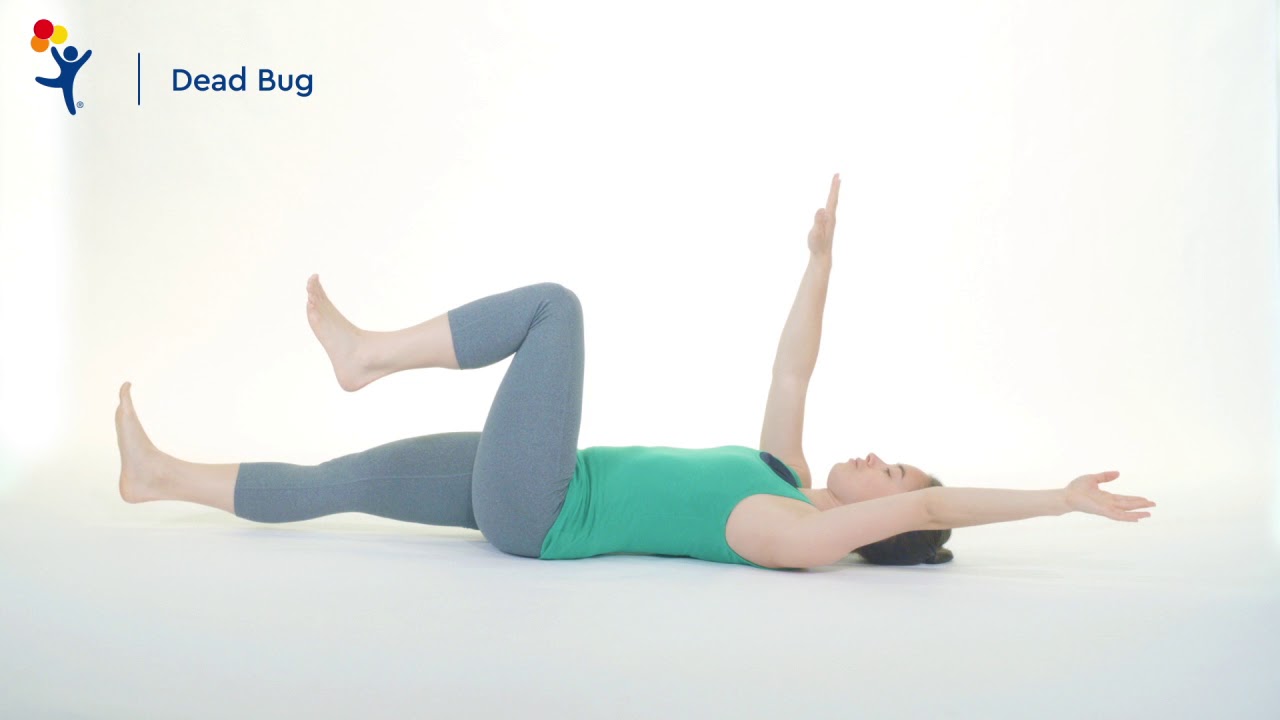
Dead Bug
Builds anti-extension core stability.
Key cue: Press your low back into the floor and move the arm and leg slowly away.
Area
full body
Level
beginner
Volume
3 × 8/side
Goal
recovery
How to do it
- 1Lie on your back with your arms reaching up to the ceiling and your hips and knees bent to 90 degrees, shins parallel to the floor.
- 2Gently flatten your lower back towards the floor and keep it there.
- 3Breathe out and slowly lower one arm overhead and the opposite leg towards the floor, as far as you can without your back arching.
- 4Breathe in as you bring them back, then swap sides. Do 8 on each side.
Easier and harder versions
- Easier
- Keep both feet on the floor and slide one heel away, or move just the arms.
- Harder
- Straighten the legs a little more as you lower, or hold a light, soft ball between your hands (never a heavy weight over your face).
Helps with
Commonly used for:
Trunk controlBack-friendly core workPost-acute back rehab
Benefits
- Trains deep core safely
- Protects against low-back pain
- Improves limb coordination
Muscles worked
Strengthening. Strengthens your transverse abdominis, rectus abdominis and hip flexors.
Transverse abdominisRectus abdominisHip flexors
Form tips
- Move as slowly as you can: control matters more than range.
- Stop each lowering where your back begins to lift from the floor.
Common mistakes
- Letting your lower back arch off the floor.
- Holding your breath.
When to avoid or modify
- Your lower back arching off the floor as you move: shorten the movement
- Recent abdominal surgery, unless your surgeon has cleared it
- Neck strain when you lift your head: rest it on the floor
- Pregnancy beyond 16 weeks: lying flat on your back can make you feel faint, so choose a side-lying or seated exercise instead
If in doubt, check with a qualified physiotherapist before continuing.