shoulder focus
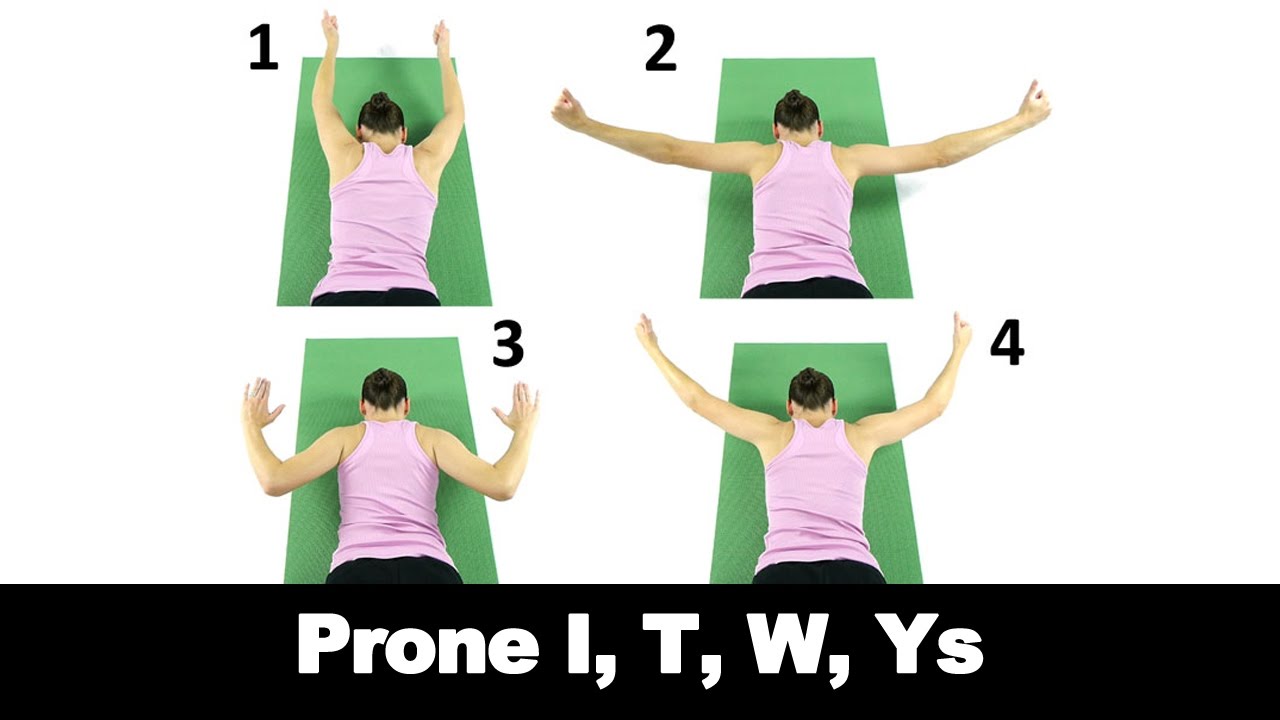
Y-T-W Raises
Strengthens posterior shoulder.
Key cue: Lead with your shoulder blades and keep your thumbs pointing up.
Area
shoulder
Level
advanced
Volume
3 × 8 each
Goal
fitness
How to do it
- 1Lie face down with your forehead resting on a rolled towel and your arms stretched out overhead in a 'Y' shape, thumbs pointing to the ceiling.
- 2Lift both arms a few centimetres off the floor, lifting from between your shoulder blades, then lower. This is the 'Y'.
- 3Place your arms out to the sides at shoulder height, thumbs up, and lift them (the 'T'). Lower, then bend your elbows and pull them down towards your waist (the 'W').
- 4Pause for a second in each shape and rest between shapes. Do 8 of each, for 3 sets.
Easier and harder versions
- Easier
- Lift only a few centimetres, and do one shape, such as the T, for the whole set.
- Harder
- Hold each shape for 5 seconds, or hold a light weight such as a small tin in each hand.
Helps with
Commonly used for:
Postural enduranceRotator cuff and mid-back strengthRounded-shoulder posture
Read more
Benefits
- Strengthens upper back
- Improves posture
- Balances heavy chest training
Muscles worked
Strengthening. Strengthens your rear delts, mid/lower trapezius and rhomboids.
Rear deltsMid/lower trapeziusRhomboids
Form tips
- Keep your thumbs pointing up and your neck long.
- Lift only as high as you can without shrugging.
Common mistakes
- Shrugging your shoulders up to your ears.
- Lifting your head or arching your lower back.
When to avoid or modify
- Shoulder pain as you lift your arms: lift less, or skip it
- Pregnancy (prone position)
- Neck pain: keep your forehead on the towel and don't lift your head
- Recent shoulder surgery, unless your surgeon has cleared it
If in doubt, check with a qualified physiotherapist before continuing.
Where to go from here
The ladder